

From across the room, a marquise and an oval look almost the same. Slip the ring on and the resemblance ends there. Both are elongated brilliant cuts, built for length rather than roundness, and from a few feet away they can look like near twins. Look closer, you’ll notice the differences show up fast: how they sparkle, how they sit on the hand, what they cost, and how much protection the setting needs to do. Comparing marquise vs oval, across sparkle, finger effect, price, bow-tie, and setting choice turns a fuzzy decision into a clear one.
The Marquise Cut - Overview

Legend says Louis XV commissioned the marquise cut shape to match the smile of his mistress, the Marquise de Pompadour. Picture a pointed oval: two sharp tips, a wide curved belly in the middle, a boat-like outline that narrows sharply at each end. Like the oval, cutters shape it as brilliant, angling triangular and kite-shaped facets to throw light back rather than using the flat step-cut planes you'd see on an emerald or Asscher.
Carat for carat, marquise covers more of the finger than most other diamond shapes, which is part of why it reads as dramatic even at a modest carat weight (worth confirming against a specific stone's measurements, since exact coverage varies by cut). Where oval leans soft, marquise leans bold. That's the core of marquise diamond vs oval: subtle versus dramatic.
Key Characteristics
Those pointed tips of a marquise need real protection, which is why V-prongs, or a bezel, show up on almost every marquise setting; without them, the corners chip over time. The length-to-width ratio usually falls between 1.75 and 2.15, noticeably more elongated than oval's proportions. Face-up size appears visually about 15 to 20 percent larger than a round brilliant of the same carat weight. That figure shifts with cut quality, so treat it as a general range, not a fixed number. Marquise also tends to cost less per carat than oval, one of the clearest differences in marquise cut vs oval.
The Oval Cut - Overview

Oval takes the opposite approach. It's become one of the more requested engagement ring shapes in recent years. Where marquise points and narrows, oval curves the whole way round: no tips, no corners, just a smooth ellipse that reads as a stretched round brilliant. Cutters shape it the same way, as a full brilliant, building the facet pattern for maximum light return rather than the broad flat mirrors of a step cut. Oval keeps the classic round silhouette that most people already know, just longer, so the shape feels familiar rather than unusual. That familiarity is a big part of why oval vs marquise diamond comparisons often start with buyers who already loved the round but wanted more visual size for the money.
Key Characteristics
No sharp points means almost no setting restrictions. Its length-to-width ratio sits lower, typically 1.35 to 1.50, so the elongation reads gentler than marquise's sharper stretch. Face-up size runs about 10 percent larger than a round of equal carat weight, a smaller jump than marquise but still a real gain. Oval's popularity pushes its price per carat slightly above marquise, the trade-off for choosing the more familiar shape.
Marquise Cut vs. Oval Cut - Head-to-Head
Side by side, marquise and oval agree on more than they disagree on. The table below breaks down oval vs marquise cuts at a glance.
| Feature | Marquise Cut | Oval Cut |
|---|---|---|
| Shape | Pointed at both ends, elongated football silhouette | Rounded ellipse, no sharp points |
| Finger Coverage | Excellent, largest surface area of any shape | Excellent, shallower cut than round |
| Sparkle | Bold, directional flashes | Consistent, all-over shimmer |
| Bow-Tie Effect | Present, often more noticeable | Present, varies by cut quality |
| Setting Risk | Points need V-prong protection | No sharp points, most settings work |
| Price vs. Round | Lower per carat, less demand | Lower per carat, but more than marquise |
| Style Character | Bold, dramatic, statement-making | Soft, feminine, modern-classic |
| Best For | Maximum drama and length | The round look, with more size |
Also Read: Dutch Marquise vs Marquise: Find out which shape stands out most.
Sparkle
Both cuts are brilliant, so the underlying sparkle mechanics match: dozens of small facets scattering light rather than a handful of large mirrored planes. Marquise throws that light in sharper, more directional flashes because of its narrower profile, whereas oval spreads the same brilliance more evenly across a wider face. Neither one sparkles "better" in any measurable sense. If you’re deciding between marquise vs oval diamond, it usually comes down to taste, not quality.
Finger Coverage and Elongation
Round and cushion cuts sit closer to the knuckle, but marquise and oval both stretch visually toward the fingertip. Marquise pushes that elongation further because its sharp points add apparent length beyond what the carat weight alone would suggest. Oval elongates too, with a rounder, gentler finish overall. Carat for carat, both still face up larger than a round brilliant of the same weight.
The Bow-Tie Effect
Elongated brilliants carry a bow-tie: a dark band across the center that appears when certain facets reflect the viewer's own silhouette instead of light. Nearly every marquise and oval shows one to some degree, and how visible it looks depends heavily on the individual stone's cut proportions. Marquise bow-ties tend to read a little darker, since the narrower waist concentrates that shadow into a smaller space. Bow-tie ratings vary from stone to stone, even within the same certified grade. Treat them as a rough guide, not a guarantee, and ask for a 360-degree video or see the stone in person before deciding.
Price Comparison
Round brilliant sets the ceiling for price per carat, and both marquise and oval sit below it. Marquise is usually the more affordable of the two. That's a result of lower demand, not a difference in the cutting itself. Oval has moved into the mainstream over the past several years, and that popularity now carries a small premium over marquise at equivalent carat and quality. Lab grown diamonds and moissanite bring the prices of both shapes down further, often by a wide enough margin that carat size becomes far more flexible for either cut.
Setting Compatibility
Marquise asks a little more of its setting. Its points are the most exposed part of the stone, so V-prongs or a bezel edge sit right at each tip, protecting the corners through years of wear. East-west marquise settings have picked up popularity recently, partly because turning the stone sideways reduces some of that point exposure at the hand's most active edge.
Marquise or Oval - Which Is Right for You?
Both shapes work well for an engagement ring. The decision usually comes down to two things: how bold you want the ring to look, and how much you want to think about setting protection down the line.
Choose the Marquise Cut If…
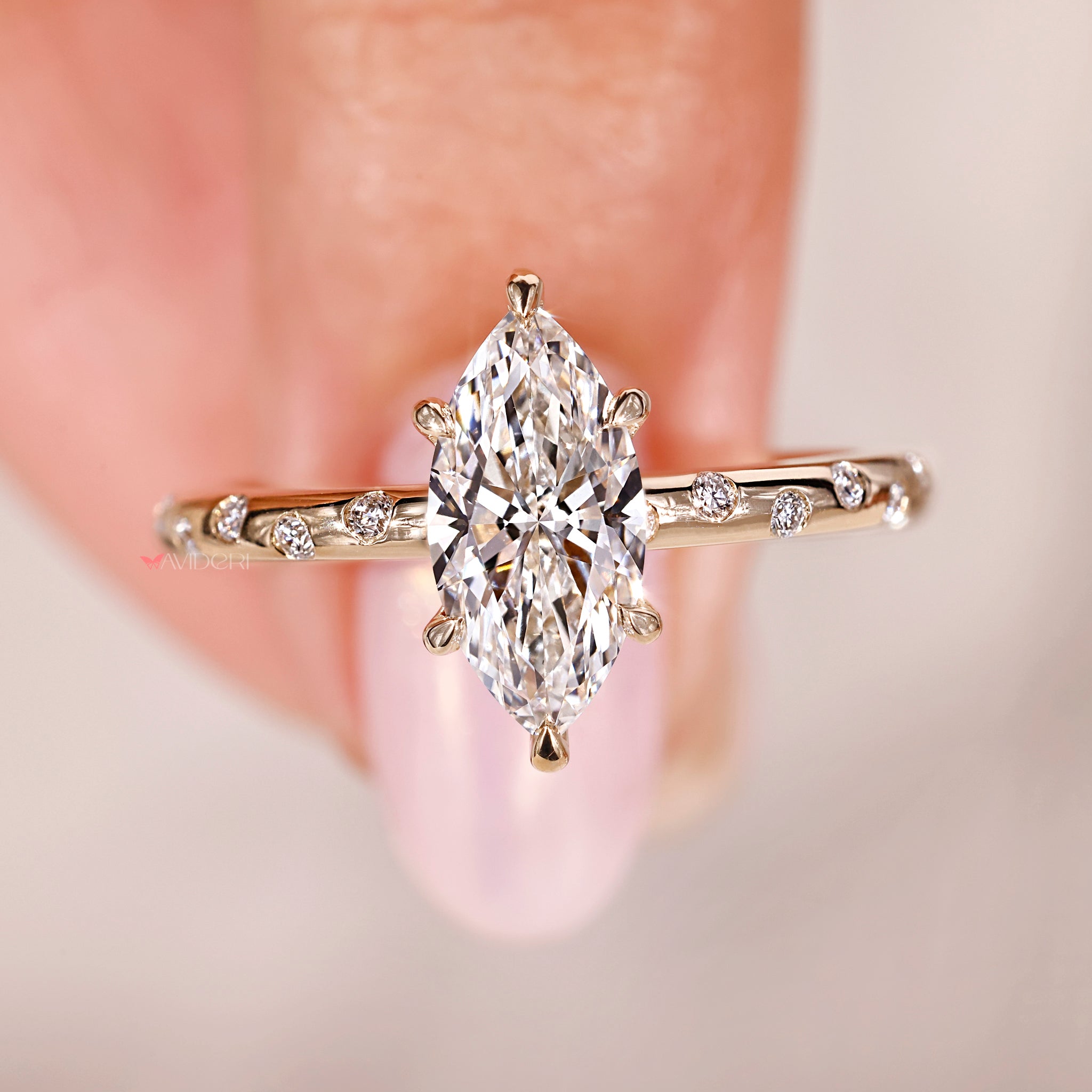
Marquise Diamond Ring With Flush Setting Band
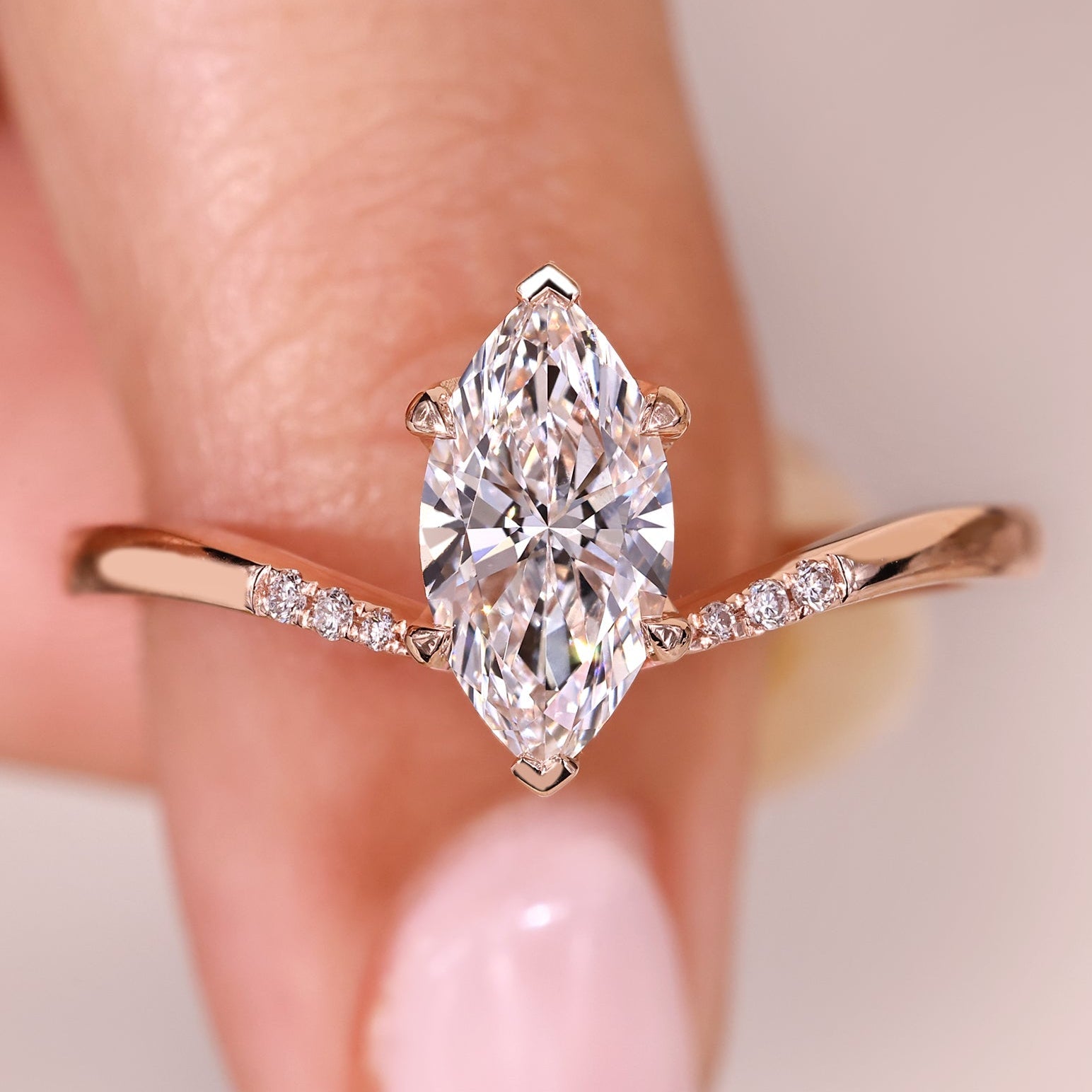
Marquise Diamond Ring with Pave Style Band
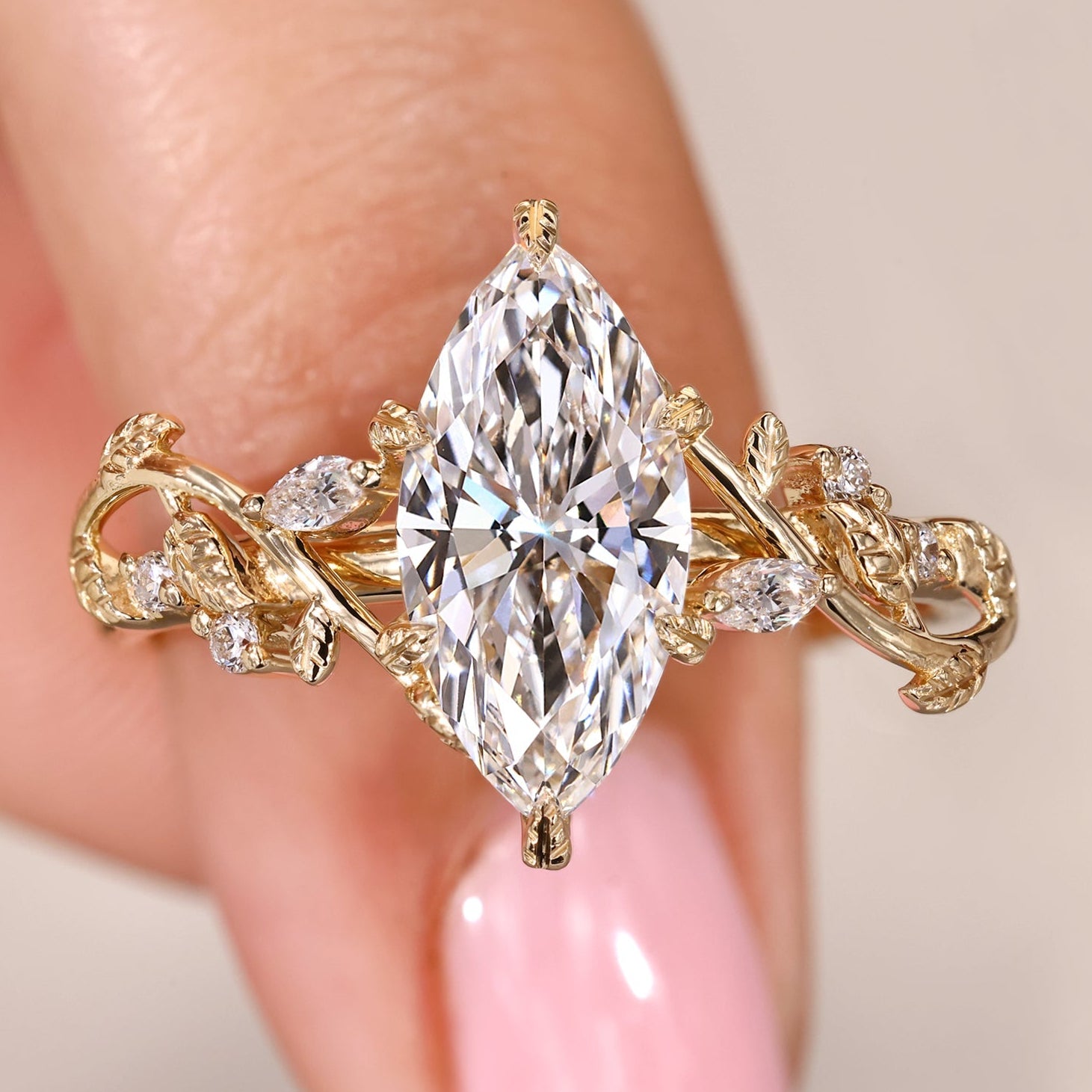
Marquise Cut Diamond Ring with Marquise and Round Side Stone
This shape rewards buyers who want a ring that reads as bold and deliberate. It also tends to cost less per carat than oval for that same visual impact. The trade-off: the setting has to protect those points for daily wear.
Choose the Oval Cut If…
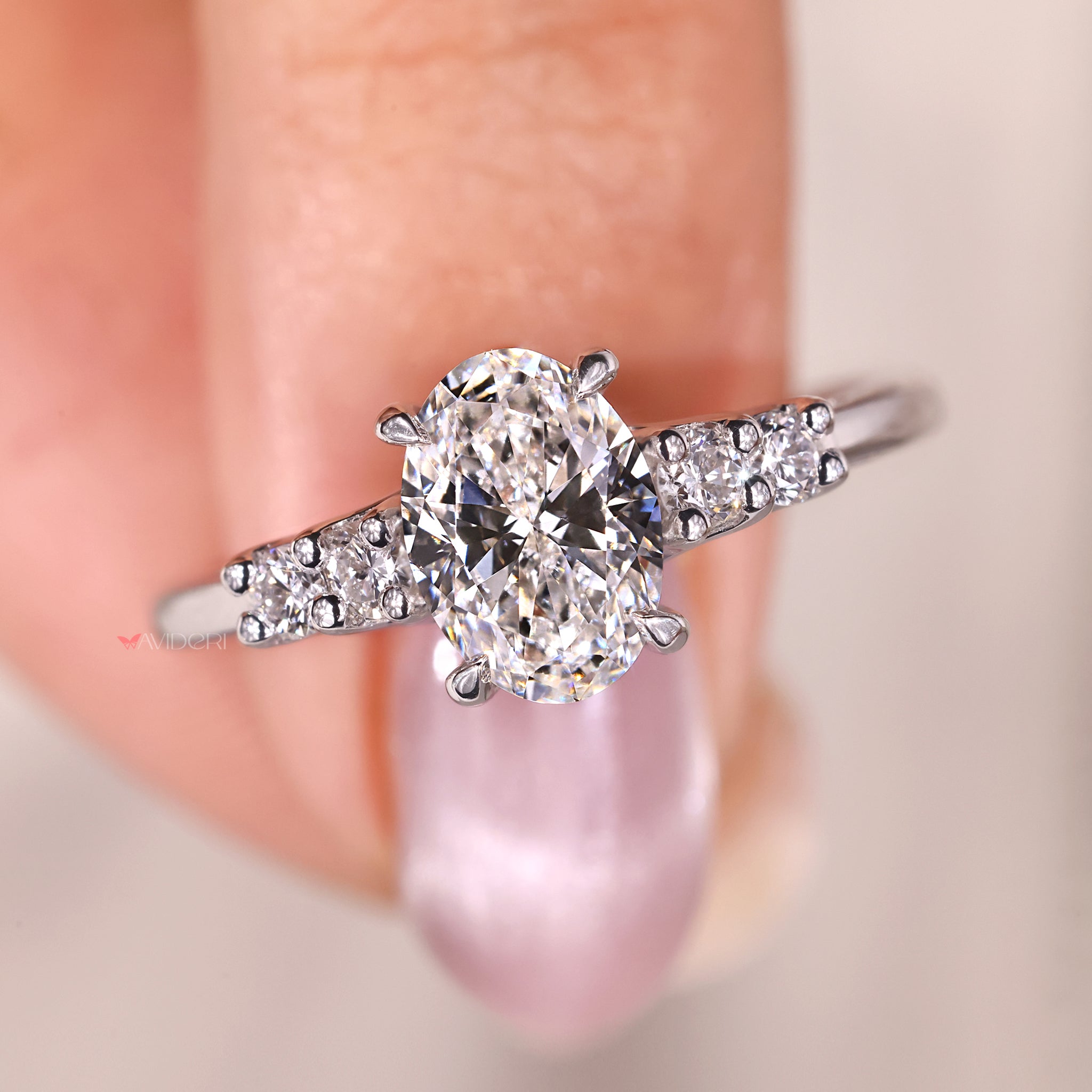
Oval Diamond Engagement Ring With Leaf Accent
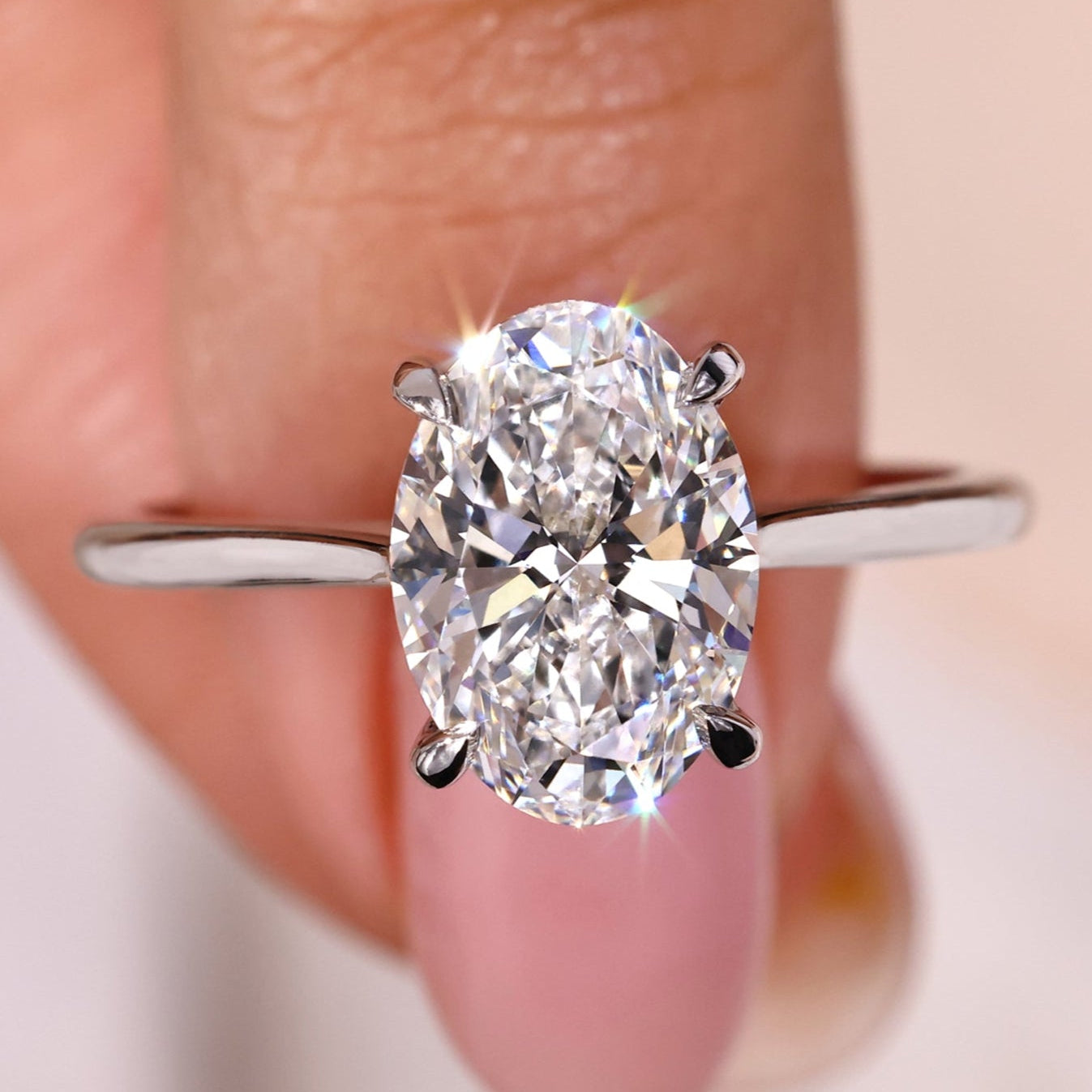
Oval Diamond Engagement Ring - Cathedral Setting

Oval Shaped Engagement Ring With Bridge Accent Setting
This shape fits buyers who want the classic round look without paying round's price. It works with nearly any setting and skips special protection. And it still delivers the elongated, finger-flattering length a round brilliant can't.
Consider Moissanite for Either Shape
Both shapes are available in moissanite at Avideri. Moissanite has a higher refractive index than diamond, a verified optical property, and that's part of why it can throw more fire per dollar; the exact difference in visible sparkle is more subjective, so judge it in person rather than by spec sheet alone. IGI-certified lab grown diamond versions cover both cuts too, for anyone who wants certification alongside the shape they've chosen.
Conclusion
Marquise and oval both elongate the finger and add real brilliance, at a lower cost than a round of equal size. The decision comes down to how bold you want the outline to look, and how much setting protection you're willing to think about. Browse Avideri's marquise and oval ring collections side by side, or book a virtual appointment to see both shapes on camera before you decide.
Two Iconic Cuts, One Perfect Choice
Not sure which shape suits you best? Take a closer look at marquise and oval rings, then create a custom design with your preferred diamond, setting, and personal details to make your engagement ring truly yours.


