


An engagement ring is supposed to represent a beginning. The coffin shape, by almost every cultural association, represents an ending. Put the two together, and you get something most jewelry traditions would call a contradiction and something a growing number of couples are calling exactly right.
The coffin engagement ring is not simply a Gothic fashion choice or a niche internet aesthetic. It is the endpoint of a long, strange, and surprisingly moving journey through Western history, from Renaissance philosophy to Victorian grief culture, from 20th century subcultures to modern custom jewelry – understanding where the coffin shape in jewelry actually came from changes how the ring reads entirely.
What Is a Coffin Engagement Ring?
A coffin engagement ring centers on a coffin-cut gemstone: a rectangular or slightly tapered stone with straight sides and pointed or squared-off ends, shaped to echo the silhouette of a coffin or casket. The cut produces a long, geometric outline with flat facets that emphasize clarity and shape over the prismatic fire of a brilliant cut.
The shape works in diamonds, moissanite, black diamonds, sapphires, and a range of colored and alternative gemstones. Our coffin cut diamond guide covers the technical details of the cut, stone selection, and proportion considerations in full. This article focuses on where the shape came from and what it has meant across the centuries before it became a center stone choice.
The Memento Mori Tradition
To understand the coffin shape in jewelry, you need to start not with Gothic fashion but with a Latin phrase: memento mori. It translates roughly as “remember you must die” and for several centuries in Western Europe, it functioned less as a morbid slogan than as a genuine philosophical practice.
Memento mori jewelry refers to 16th through 18th century pieces created as a reminder of the inevitability of death and the need to live with intention. The idea was rooted in Christian theology that awareness of mortality kept a person morally grounded, resistant to vanity, and oriented toward what mattered beyond the immediate world. Skulls, hourglasses, coffins, and skeletal imagery appeared in art, architecture, and personal objects. They made abstract mortality feel more concrete.
Rings were the most common vehicle for this symbolism. The 16th century saw an increase in bequests for mourning rings, often plain bands engraved with a sentiment referencing the departed, with money left specifically for their creation alongside a specified list of mourners. The practice was not considered morbid in the way modern culture tends to read it. In medieval Europe, where plague, famine, and war were facts of everyday life, death was not a rare tragedy, and jewelry that acknowledged it carried philosophical weight rather than simply expressing grief.
Wearing Symbols of Death

By the 16th and 17th centuries, goldsmiths across Europe were producing memento mori objects of considerable sophistication. The British Museum’s collection includes a gold ring from approximately the mid-16th century, likely Flemish in origin, whose bezel takes the form of a book containing a white recumbent figure with a skull and hourglass. The back of the hoop is formed as two hands clasping a heart. Death and love literally joined in a single object.
The British Museum also holds a gold pendant in the form of a coffin, enamelled in black and white, with a hinged rock-crystal cover revealing a skeleton in high relief. The reverse is enamelled with flames, emblems of mortality and the Passion. It is attributed to the 16th century and represents a tradition that existed across Germany, the Netherlands, France and England simultaneously.
A particularly widespread variant was what was sometimes called a “coffin ring” a piece with a tiny hinged compartment shaped like a casket. While rumored sometimes to hold poison, these compartments more commonly held precious relics: a lock of hair, a fragment of scripture, or a portrait of a departed loved one, making the ring a deeply intimate, wearable shrine
These were not Gothic accessories in any modern sense. The skull and the crossbones motif carried the message that life should be lived fully and that time was finite; the wearer was reminded not just of death but of the urgency of living. The coffin shape specifically carried Christian connotations about resurrection and judgment – what the body returns to, and what might come after.
From Mortality to Mourning Jewelry
A memento mori ring referenced death as a philosophical condition. A mourning ring commemorated a specific person who had died. In the 17th century, the memento mori style began to shift toward use in commemorating the death of a particular person. Rings would have the name, age, and date of death of the deceased engraved into gold, with skull, skeleton, and coffin imagery still common, and black enamel used if the deceased was married and white if unmarried.
The Metropolitan Museum of Art holds a 1733 American mourning ring with a coffin-shaped cut-glass bezel, a documented object that demonstrates how coffin form had moved from philosophical symbol to personal memorial within the span of roughly two centuries. The shape no longer simply reminded the wearer that death exists. It now pointed at a specific death, a specific person, a specific loss.
This transition matters for understanding what coffin jewelry means. The shift from abstract mortality to personal grief is also a shift from philosophy to love. A mourning ring was an act of devotion to someone who was gone. The coffin shape, by carrying that association, became over time connected not just with death but with the depth of attachment that makes loss painful.
Coffin Jewelry: From Death to Devotion
It is worth being careful here. Historical coffin-form jewelry was not universally a romantic love token. Much of it was philosophical, religious, or commemorative. Memento mori symbols merged with memorial jewelry containing hair, coffin imagery, initials, and dates. The result was both morbid and deeply romantic. But the romantic reading emerged gradually rather than being the original intent.
What genuinely did exist in the historical record is the combination of death symbolism and love symbolism in single objects. A mid-16th century British Museum ring combines skeletal and hourglass imagery within its bezel. Its clasped hands and heart connect love with mortality. The message is not that love ends with death. It is closer to the opposite: that love is what makes mortality matter.
Even Queen Victoria’s own engagement ring was a serpent symbol used in both memento mori and mourning jewelry to represent eternal love and remembrance. The line between death symbolism and devotion was never as clear as modern categories imply.
The idea that a commitment could outlast physical life – that love is precisely what persists when everything else ends – was not invented by contemporary alternative-jewelry culture. It has a long and well-documented history in the objects people chose to wear.
Gothic Revival: The Rise of Alternative Jewelry
Victorian mourning culture industrialized coffin and death – adjacent jewelry in ways earlier centuries had not. When Prince Albert died in 1861 and Queen Victoria wore mourning black for the remaining 40 years of her life, an entire mourning jewelry industry emerged. Whitby jet, vulcanite, and black enamel produced an aesthetic that filtered through every level of British society.
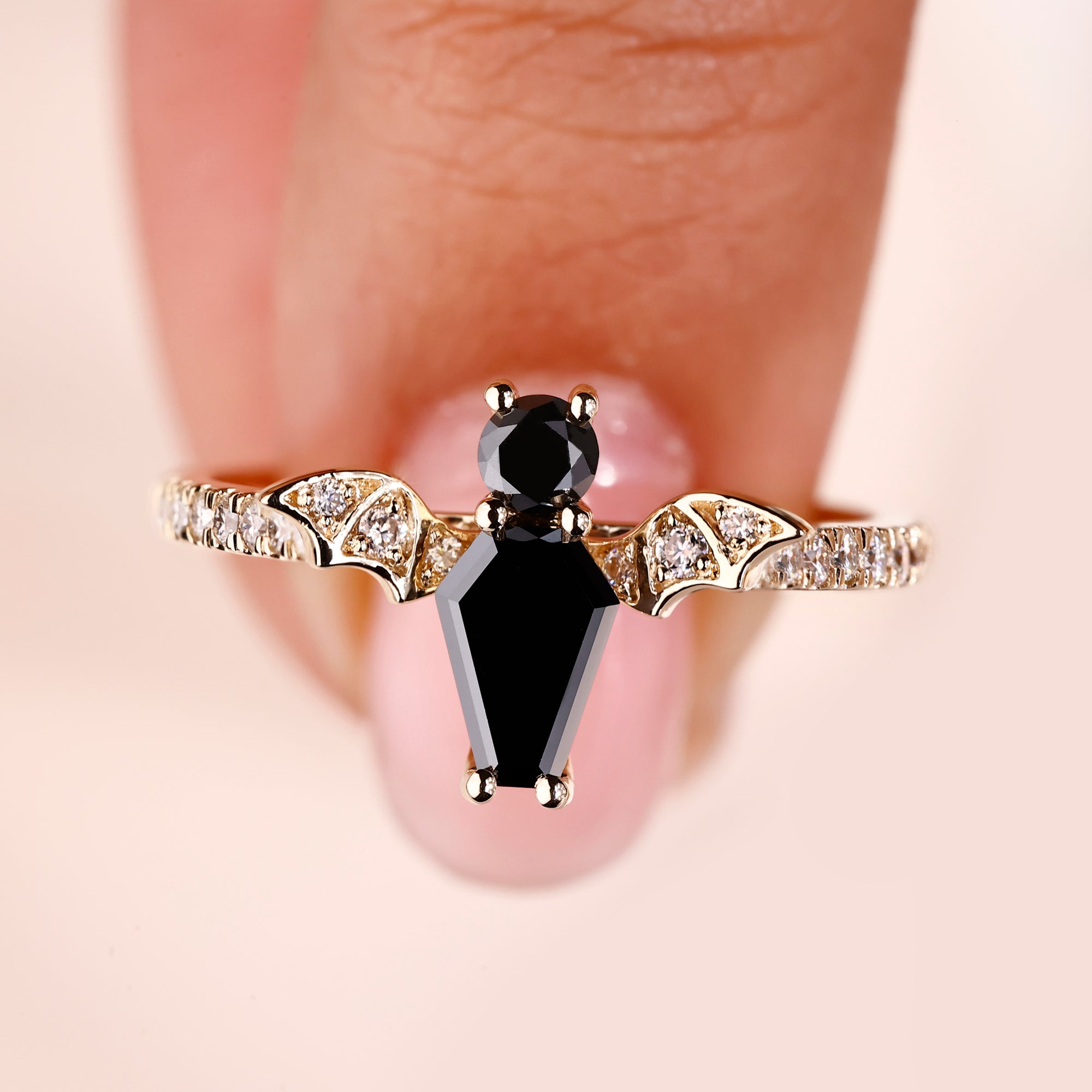
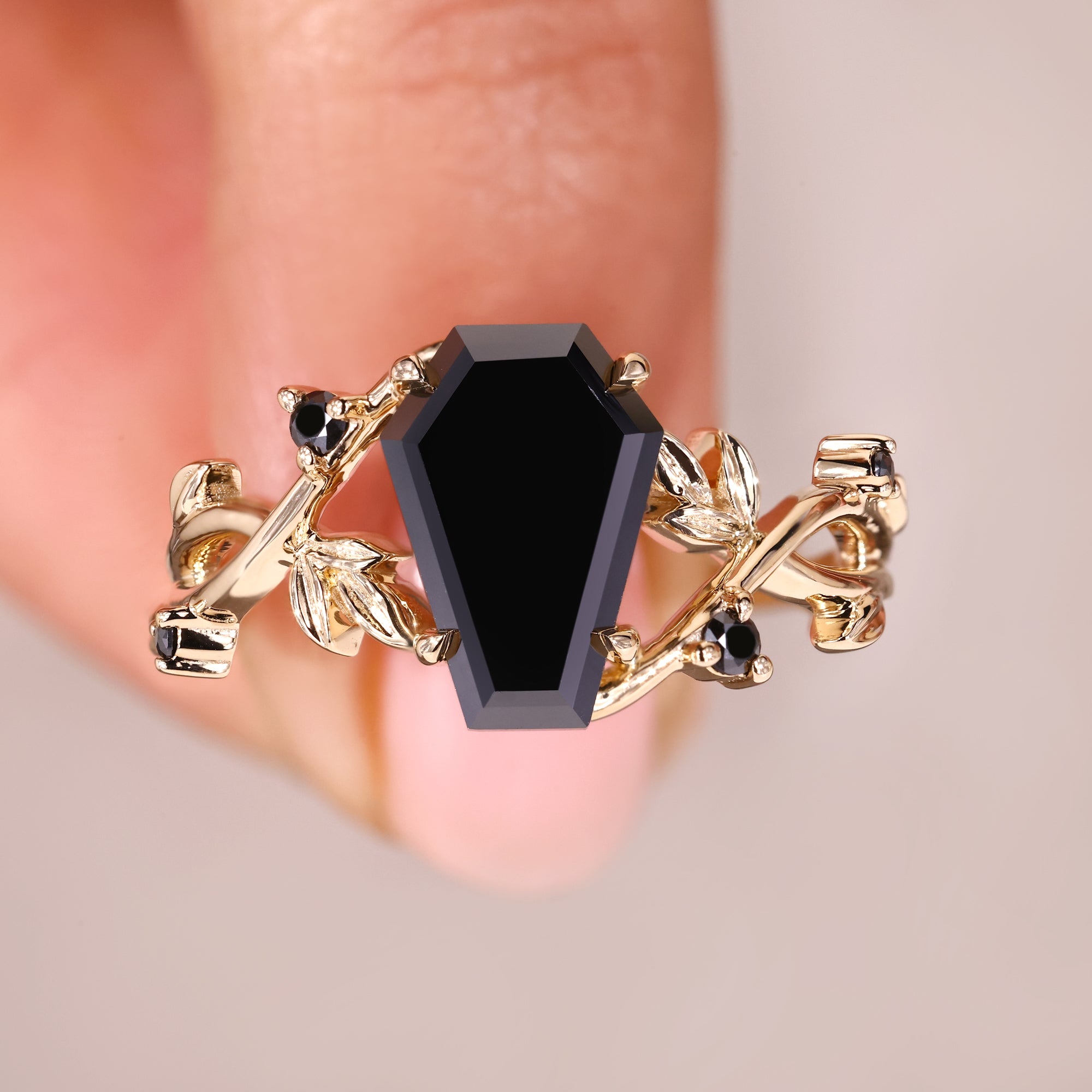
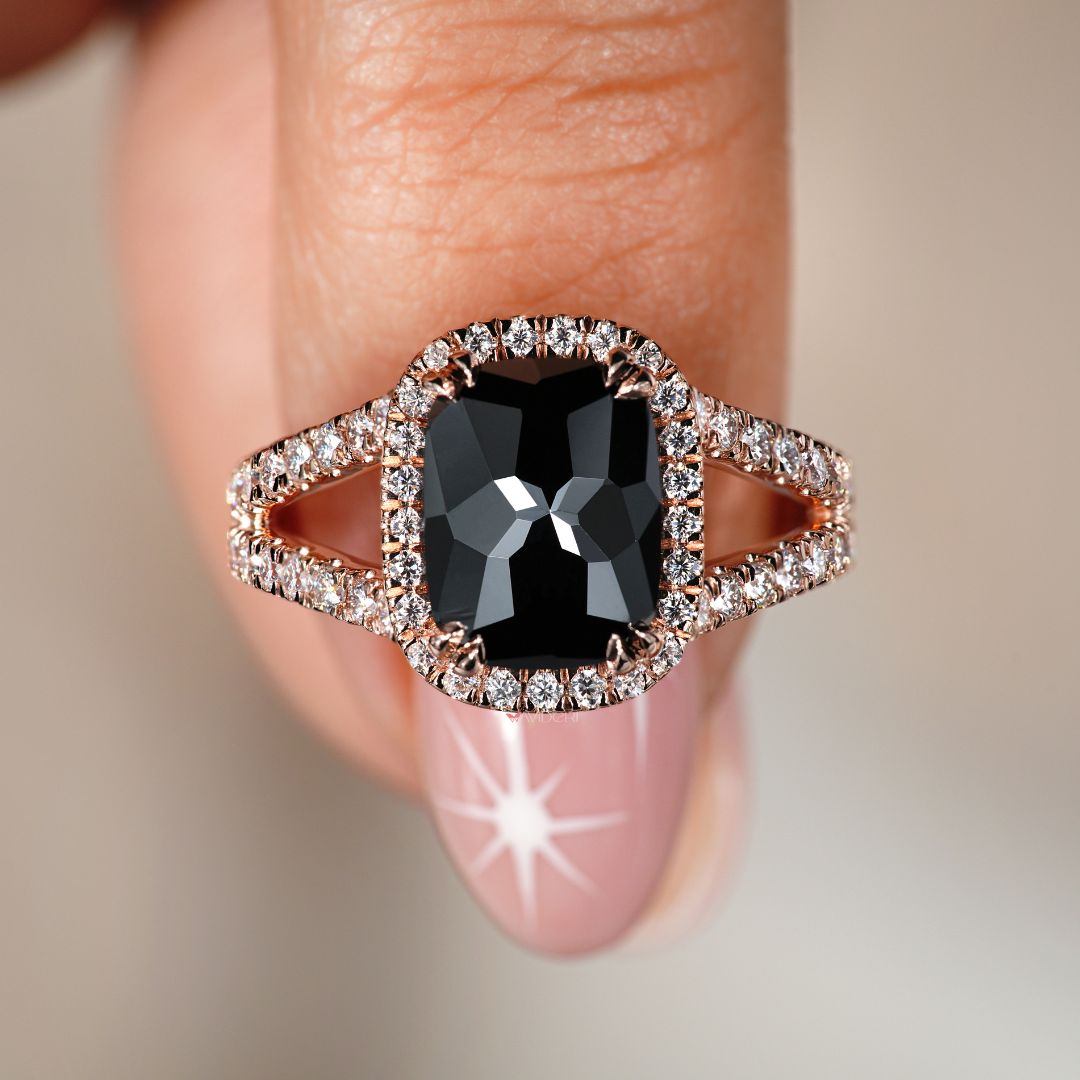
That association – dark jewelry, black materials, death imagery – did not disappear when Victorian mourning culture faded. It migrated. Through the early 20th century, biker culture adopted skull and coffin motifs as symbols of rebellion and defiance. That alternative identity later found a place in modern coffin engagement ring designs. By the late 1970s and 1980s, Gothic subculture had adopted and formalized the aesthetic not to process grief but to claim the imagery deliberately as a statement about identity and a rejection of mainstream sanitized culture.
By this point, the coffin shape carried at least three different cultural histories simultaneously: philosophical memento mori, Victorian mourning devotion, and subcultural rebellion. What it did not yet carry, in any consistent way, was a modern gemstone cut.
From Coffin Imagery to the Modern Coffin Cut
The modern coffin shaped engagement ring is a different object from historical coffin-form jewelry in one important respect: it does not use a coffin shaped bezel, compartment, or decorative element. It uses a coffin-shaped center stone.
This distinction is worth being precise about. A 17th century coffin ring used the shape as a symbolic visual reference to mortality worn on the finger. A contemporary coffin cut engagement ring uses the shape as a gemstone cut architectural outline for the stone itself. The symbolism is inherited rather than primary. The shape entered modern fine jewelry through layered historical associations. It was not a direct continuation of earlier traditions.
That filtering is actually what makes the modern coffin cut ring interesting. The stone carries the weight of centuries of meaning without being constrained by any single one of them. Wearers can draw on the memento mori tradition, the mourning devotion tradition, the Gothic identity tradition, or simply the geometry and all of those readings are historically legitimate.
What Coffin Engagement Rings Symbolize Today?
There is no single answer. The coffin shape has accumulated enough different meanings across enough different contexts that claiming one universal symbolism would be reductive. What the shape makes available, rather than what it prescribes, is the more honest way to approach it.
For some wearers, the coffin engagement ring represents devotion that acknowledges mortality, a commitment that does not pretend life is unlimited. That honesty can make it feel more serious and meaningful. Individuality matters to others, reflecting a refusal to default to the round brilliant solitaire without considering whether it represents who they are. A Gothic aesthetic identity may be the main reason for another wearer, using the coffin shape as a visual language already familiar to them.
There are also wearers drawn to the architectural geometry of the cut itself, who may have minimal interest in the historical symbolism but find the shape more compelling than conventional options. And some wearers connect the coffin with transformation, endings and beginnings as a continuous cycle rather than opposites.
None of these interpretations is more correct than the others. The strength of the coffin shape as a symbol is its capacity to hold multiple readings simultaneously.
Why Couples Choose Coffin Engagement Rings
Many buyers are looking for something outside the conventional hierarchy of engagement ring shapes – round, oval, cushion – and want a stone that reflects their actual aesthetic rather than a default inherited from mainstream jewelry culture. The coffin cut sits genuinely outside that hierarchy in a way that pear or marquise do not quite manage anymore.
Some buyers have a specific connection with Gothic or dark-romantic aesthetics that makes a conventional diamond feel inconsistent with how they present themselves everywhere else. The coffin engagement ring resolves that inconsistency.
Others are drawn to the symbolism deliberately – the idea that an engagement is a commitment serious enough to acknowledge the whole of life, not just the easy parts. A ring that quietly references mortality is also a ring that quietly references what makes the commitment meaningful.
And some buyers are simply attracted to the stone shape itself: the long, flat geometry, the way it reads as a deliberate design choice rather than an inherited convention. The coffin cut reads as intentional in a way that communicates something about the person wearing it.
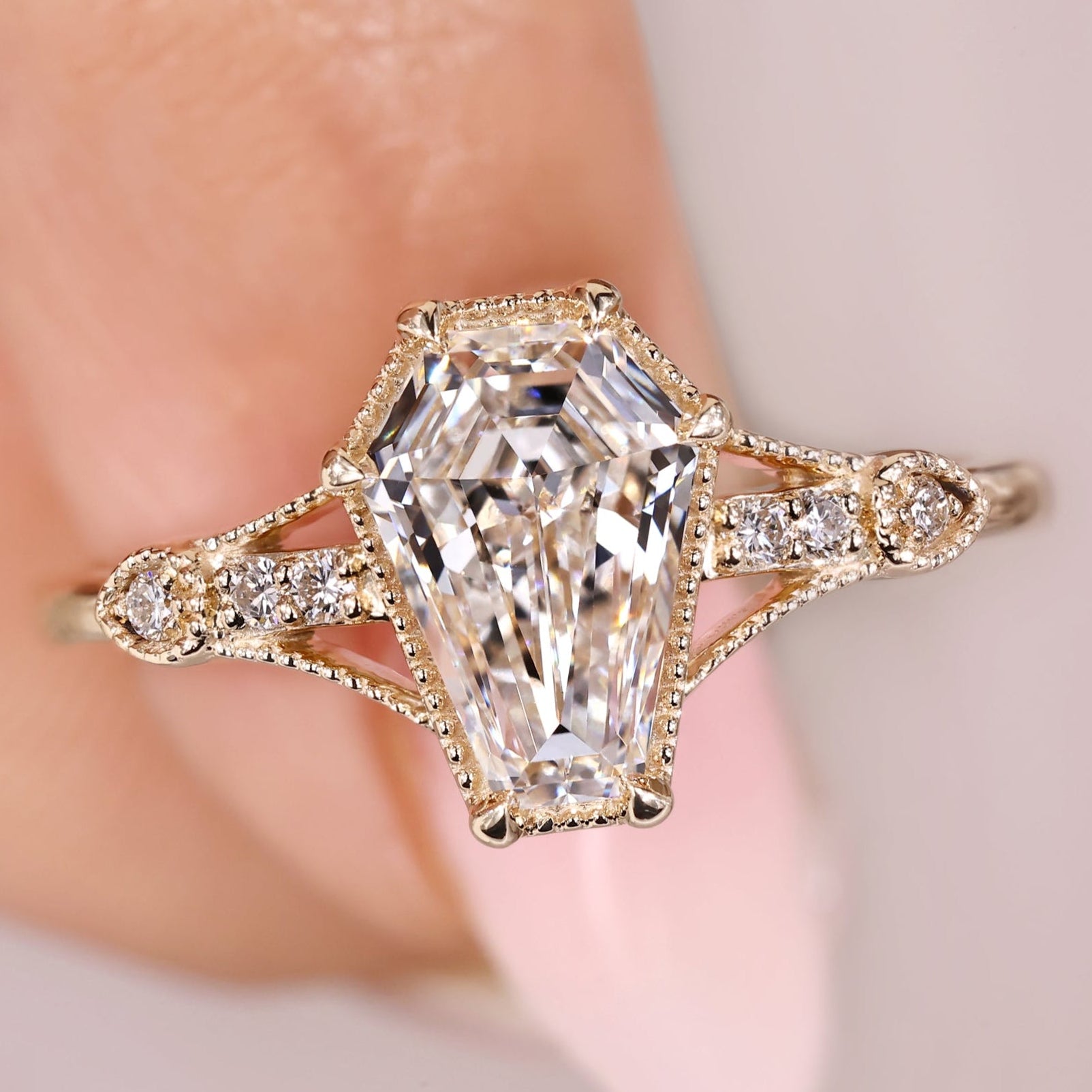
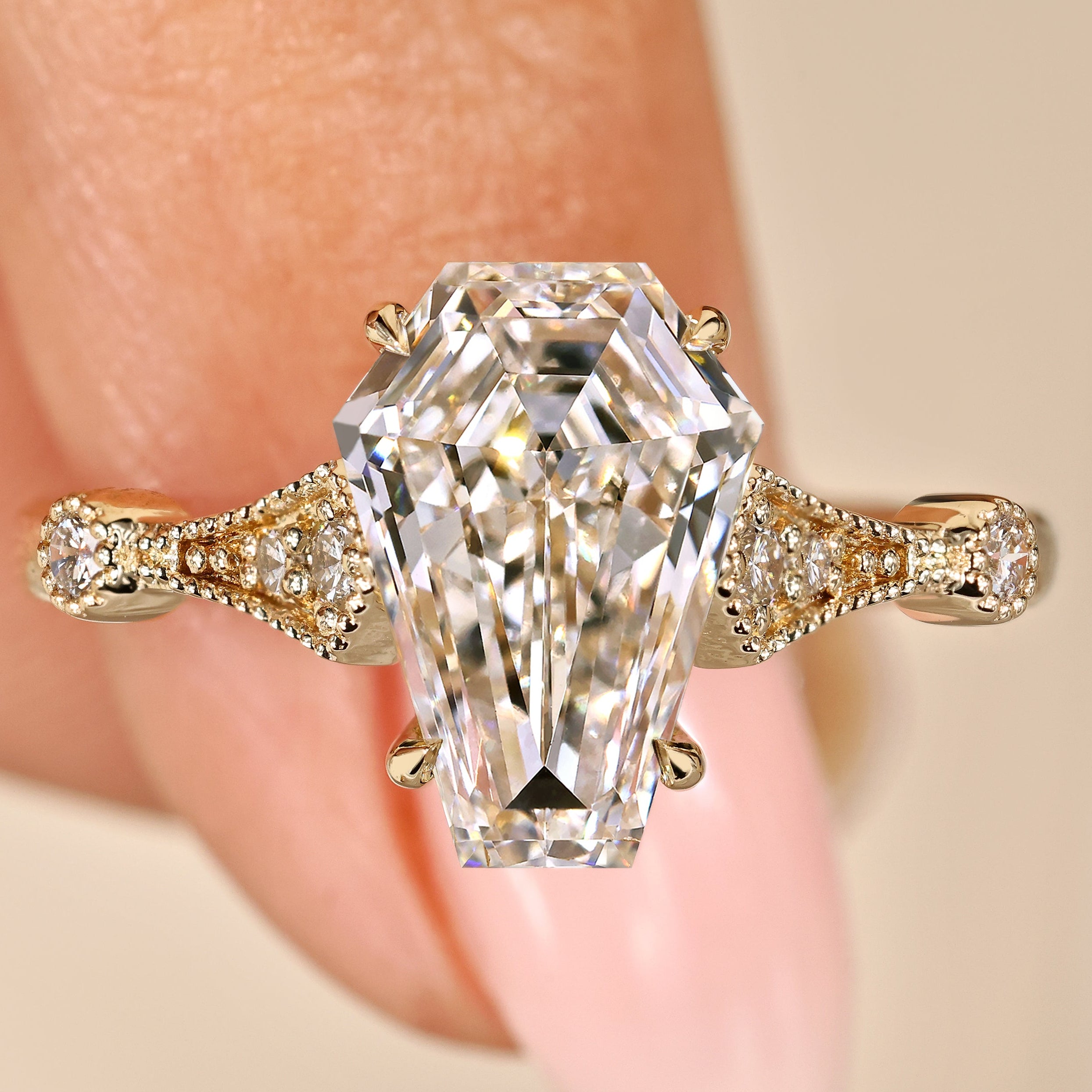
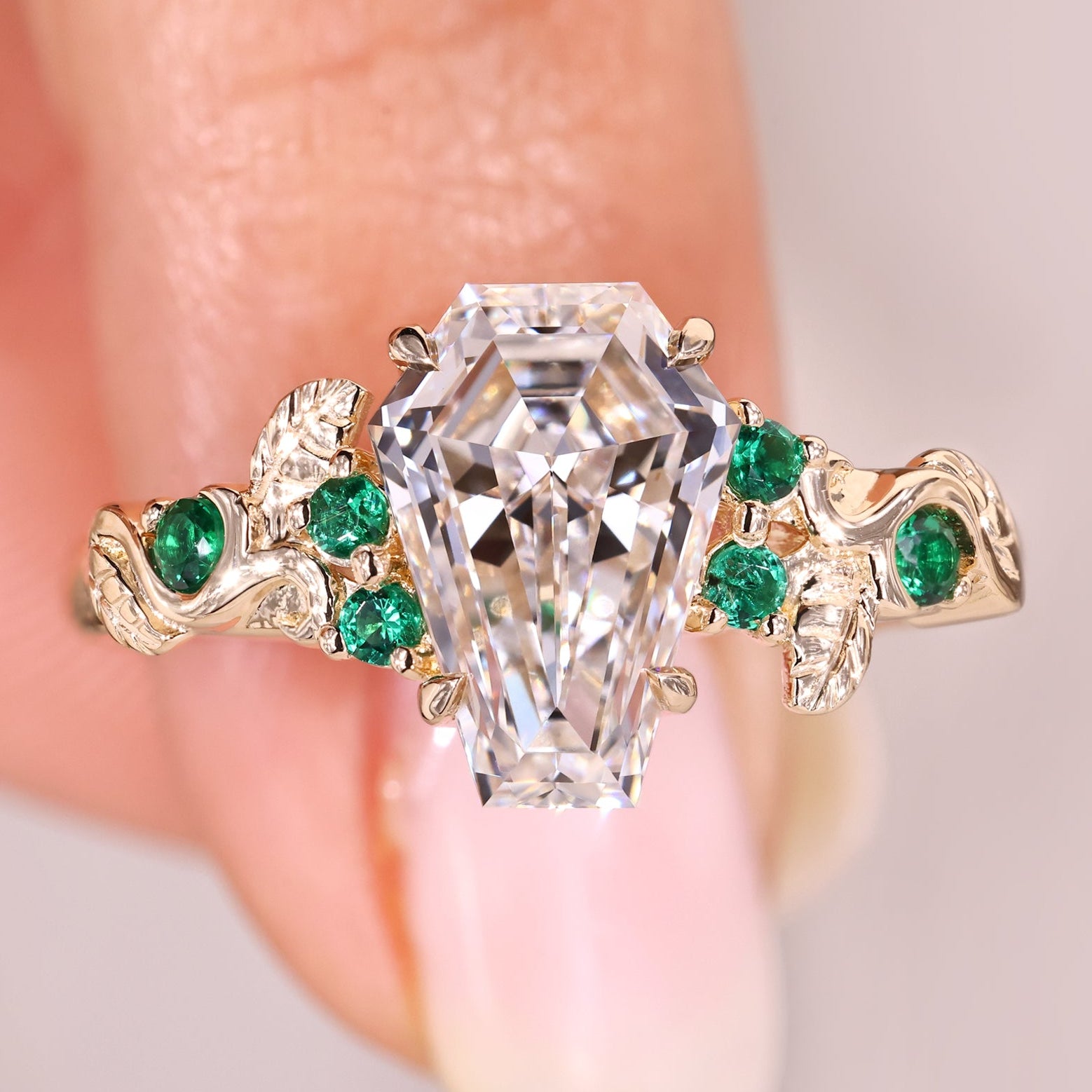
Browse our full coffin diamond rings collection to see how the cut translates across different settings, metals, and stone choices.
Coffin Engagement Rings Beyond the Gothic Look
One of the most persistent misconceptions about coffin engagement rings is that they require a full Gothic aesthetic to make sense: black metal, dark stones, skull details and heavy ornamentation.
They do not. The coffin-cut center stone works across a much wider range of settings and aesthetics than the name implies.
A coffin cut lab grown diamond in a simple four-prong solitaire setting in 14K yellow gold reads as architectural and slightly unconventional rather than Gothic. The same stone in a delicate rose gold bezel setting reads as vintage-adjacent. In a white gold pave band, it is contemporary and striking. The shape carries its associations lightly when paired with minimal settings and conventional metals.
Black moissanite and black diamonds do occupy the darker end of this range, and they work beautifully for buyers who want the full alternative aesthetic. But lab grown diamonds in near-colorless grades also work with this cut, allowing the geometry to be the statement rather than the color.
The coffin engagement ring is a choice. That does not mean it requires an alternative setting. The shape is unusual enough on its own.
Is a Coffin Engagement Ring Right for You?
It tends to be a strong fit for buyers who have an existing aesthetic connection with Gothic, dark-romantic, or alternative design; want a gemstone shape that reads as genuinely distinctive; are drawn to the historical symbolism around mortality and devotion; prefer geometric, flat-faceted cuts over brilliant sparkle; or want an engagement ring that is more likely to start a conversation than blend into the background.
It is less likely to be a strong fit for buyers who prefer shapes with broad conventional recognition, prioritize the prismatic fire of a brilliant cut above other qualities, are uncomfortable with death-adjacent symbolism in a context meant to represent a new beginning, or want something more universally legible as a traditional engagement ring.
Death, Diamonds & Devotion: What the Shape Means
The journey from 16th century memento mori rings to a coffin-cut moissanite engagement ring is not a straight line. The shape passed through Renaissance philosophy, Christian mortality theology, Victorian grief culture, biker identity, Gothic subculture, and contemporary alternative jewelry before arriving at its current form. Each stop added a layer of meaning rather than replacing the previous one.
What connects all of those layers is a single underlying logic: that acknowledging death is not the opposite of loving life or loving another person. It is what gives both of those things their weight.
An engagement ring that references mortality does something most engagement rings do not: it asks the question that makes the commitment serious. Not “how long will this last?” but “given that it will not last forever, what does it mean to choose it anyway?“


